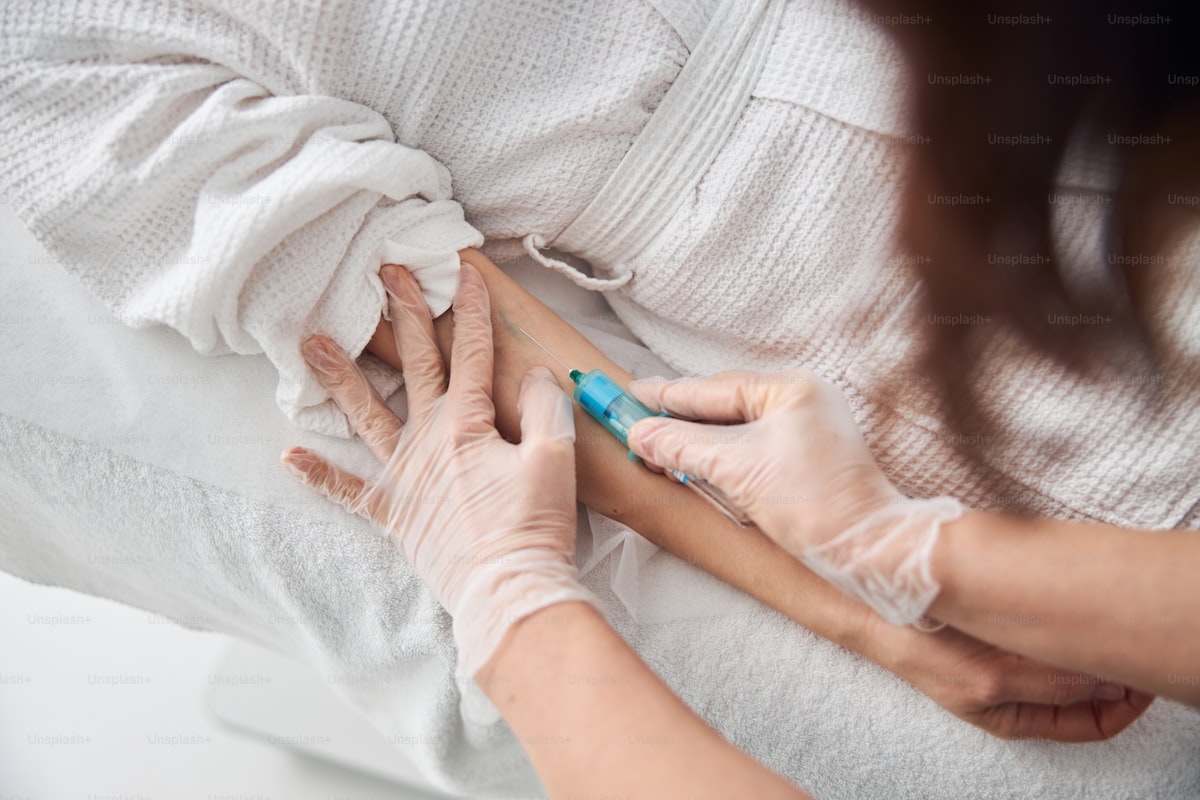

Sermorelin has a half-life of only 11 to 12 minutes. It is a trigger for a growth hormone pulse, not a slow-release depot, which is why the metabolic state at the exact moment you inject, fasted or fed, changes how well it works.
Sermorelin should be injected on an empty stomach, and for most protocols that means at bedtime at least 2 hours after your last meal. The reason is physiological, not arbitrary. The growth hormone pulse the injection is meant to reinforce happens in the fasted, sleeping state, and food, especially carbohydrate, works against it. Dosing after a meal is one of the most common reasons a correct prescription produces a weak result.
- Inject on an empty stomach, at least 2 hours after eating, and take only water afterward
- Sermorelin has a short half-life, so the metabolic state at the moment of injection matters [1][2]
- A carbohydrate meal raises blood glucose and blunts the GH pulse through somatostatin feedback
- Bedtime dosing aligns the injection with the largest natural GH pulse of the day [4]
- Growth hormone and insulin push metabolism in opposite directions [3]
Why Timing Matters at All
Sermorelin is not a sustained-release drug. The FDA-approved Geref label puts its half-life at 11 to 12 minutes after subcutaneous or intravenous administration [1], and the native GHRH(1-29) fragment it is built on is cleared from circulation within minutes [2]. It works by triggering a short burst of pituitary GH release, then it is gone.
Because the window is so brief, the conditions at the moment of injection decide how big the resulting pulse is. There is no reservoir to smooth over a badly timed dose. This is why a molecule that looks forgiving on paper is actually sensitive to when and how it is given.
The Empty-Stomach Rule
Food, and carbohydrate in particular, is the main thing that undercuts a dose. A meal raises blood glucose and insulin, and elevated blood glucose blunts the GH pulse through somatostatin feedback, the same inhibitory loop that governs GH release. Injecting into that state produces a smaller pulse than injecting fasted.
The metabolic logic reinforces it. Growth hormone antagonizes insulin action and increases the release of free fatty acids for fuel [3]. Growth hormone and insulin push metabolism in opposite directions, so dosing when insulin is high works against the fat-mobilizing, GH-favoring state the injection is meant to create. An empty stomach keeps the setting tilted the right way.
Nothing but water for at least 2 hours before the injection, and nothing but water for a couple of hours after. Alcohol and a late carbohydrate-heavy meal are the two most common ways patients unknowingly weaken their own dose.
Why Bedtime Specifically
The empty-stomach rule and bedtime dosing solve the same problem from two directions. The body's largest natural GH pulse occurs during the first deep sleep cycle. Growth hormone secretion is concentrated in slow-wave sleep, roughly 60 to 90 minutes after sleep onset [4]. Injecting at bedtime layers the sermorelin-driven pulse onto that natural peak, and by then most people are naturally in a fasted state.
This is also how the drug was studied. In the primary long-term trial of a GHRH(1-29) analog in older adults, the dose was given subcutaneously at bedtime [5], and IGF-1 rose within 2 weeks. Bedtime dosing on an empty stomach is the protocol the evidence base actually used.
The Practical Protocol
- Finish your last meal at least 2 hours before injecting
- Inject at bedtime, subcutaneously, into the abdomen or lateral thigh
- Take only water for about 2 hours after the dose
- Avoid alcohol and late carbohydrate-heavy meals on dosing nights
- Keep the timing consistent night to night, since a reinforced pulse is a nightly event
The same feedback system that blunts a poorly timed dose is what makes sermorelin safe. Because the somatostatin loop stays intact, the pituitary self-limits GH output and oversaturation is unlikely at standard doses [6]. Good timing works with that system rather than around it.
What Happens If You Dose After Eating
Nothing dangerous happens if you inject too soon after a meal. The dose is simply less effective, because the pulse it triggers is smaller. Do this consistently and the cumulative effect is a weaker IGF-1 response and a disappointing 90-day retest, which is exactly the profile behind many of the "it did nothing" reports. The fix is a timing correction, not a higher dose.
The only way to know your dosing protocol is producing a real response is to measure it. SystemLabs includes baseline IGF-1 testing and structured retesting, so a weak result from bad timing shows up as data you can act on rather than a guess.
Bottom Line
Take sermorelin on an empty stomach at bedtime, at least 2 hours after your last meal, and follow it with water only. The short half-life means the pulse is created in the moment, so a fasted state and the natural nocturnal GH peak both work in your favor. Dosing after a meal is not harmful, but it quietly weakens the therapy, and timing is the cheapest variable to get right.
Frequently Asked Questions
Should sermorelin be taken on an empty stomach?
Yes. Inject at least 2 hours after your last meal and take only water afterward. A meal, especially carbohydrate, raises blood glucose and insulin, which blunts the GH pulse through somatostatin feedback and works against the fat-mobilizing state the injection is meant to create. An empty stomach produces a stronger pulse.
Why does food affect sermorelin?
Sermorelin has a half-life of only 11 to 12 minutes, so it triggers a short GH pulse rather than releasing slowly, and the metabolic state at the moment of injection decides how large that pulse is. Elevated blood glucose from a meal blunts the pulse, and because growth hormone and insulin push metabolism in opposite directions, dosing when insulin is high undercuts the effect.
What time of day should I take sermorelin?
Bedtime, for most protocols. The largest natural GH pulse of the day occurs during slow-wave sleep, about 60 to 90 minutes after falling asleep, and a bedtime injection layers the sermorelin-driven pulse onto that peak. Bedtime is also when most people are already in a fasted state, which satisfies the empty-stomach requirement at the same time.
How long should I wait to eat after injecting sermorelin?
Take only water for about 2 hours after the dose. Since bedtime dosing is standard, most patients are simply going to sleep, which handles the fasting window naturally. Avoid a late carbohydrate-heavy meal or alcohol on dosing nights, since both raise the risk of a weaker pulse.
What happens if I take sermorelin after eating?
It is not dangerous, but the dose is less effective because the GH pulse it triggers is smaller. Done consistently, this produces a weaker IGF-1 response and a disappointing 90-day retest, which explains many reports of sermorelin not working. The correction is fixing the timing, not raising the dose.
References
- Sermorelin acetate (Geref): clinical pharmacology and half-life RxList / FDA-approved labeling, 2023. Geref (sermorelin acetate). https://www.rxlist.com/sermorelin-acetate-drug.htm
- Incorporation of D-Ala2 in growth hormone-releasing hormone-(1-29)-NH2 increases the half-life and decreases metabolic clearance in normal men Journal of Clinical Endocrinology & Metabolism, 1994. PMID: 7962295. https://pubmed.ncbi.nlm.nih.gov/7962295/
- Biological effects of growth hormone on carbohydrate and lipid metabolism (growth hormone and insulin signaling) Molecular and Cellular Endocrinology, 2020. PMC7606590. https://pmc.ncbi.nlm.nih.gov/articles/PMC7606590/
- Simultaneous stimulation of slow-wave sleep and growth hormone secretion by gamma-hydroxybutyrate in normal young men Journal of Clinical Investigation, 1997. PMC508244. https://pmc.ncbi.nlm.nih.gov/articles/PMC508244/
- Endocrine and metabolic effects of long-term administration of [Nle27]growth hormone-releasing hormone-(1-29)-NH2 in age-advanced men and women Journal of Clinical Endocrinology & Metabolism, 1997. PMID: 9141536. https://pubmed.ncbi.nlm.nih.gov/9141536/
- Sermorelin: a better approach to management of adult-onset growth hormone insufficiency? Clinical Interventions in Aging, 2006. PMID: 18046908. https://pmc.ncbi.nlm.nih.gov/articles/PMC2699646/