
The advice to refrigerate reconstituted sermorelin is not universal. The closest FDA-approved GHRH analog label instructs the opposite: do not freeze or refrigerate after mixing. Storage depends on your specific formulation, so follow the beyond-use date your compounding pharmacy assigns rather than generic internet guidance.
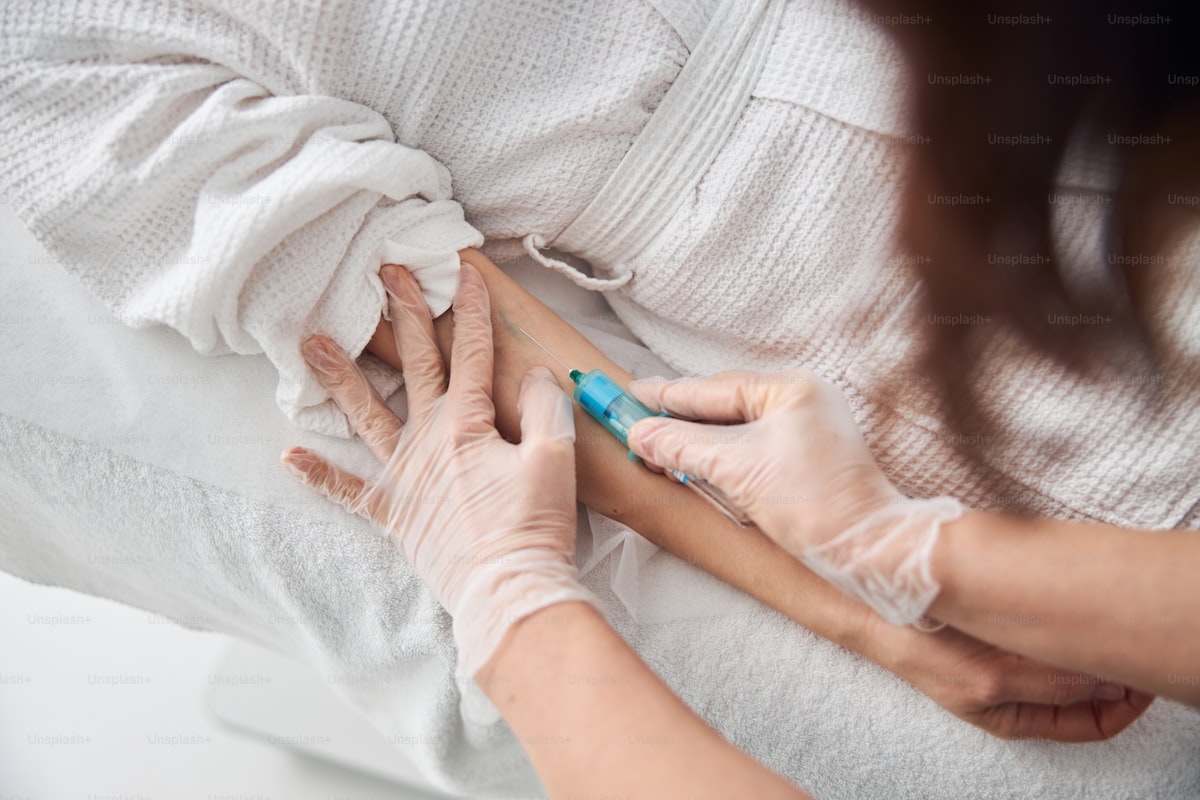
Sermorelin is given as a subcutaneous injection at bedtime. The published protocols are consistent on this: the pediatric labeling specified 30 mcg/kg subcutaneously once daily at bedtime [1], and the adult trial data used nightly subcutaneous dosing [2]. Technique is not incidental to the outcome. Timing relative to sleep and food, injection depth, and site rotation each affect either the GH response or the tolerability of a 6-month protocol.
Confirm your dose in both micrograms and syringe units with the prescribing physician or pharmacist. Unit conversion after reconstitution is where most self-administration errors occur, and the consequences run in both directions.
What You Need
- Your vial of lyophilized sermorelin powder
- Bacteriostatic water for injection, in the volume your pharmacy specifies
- U-100 insulin syringes, which have 100 units per mL
- Alcohol swabs
- A sharps container
Use short needles. The consensus recommendations on subcutaneous injection technique state that the shortest needles, currently the 4 mm pen and 6 mm syringe needles, are safe, effective, and less painful and should be first-line in all patient categories [3].
Reconstituting the Vial
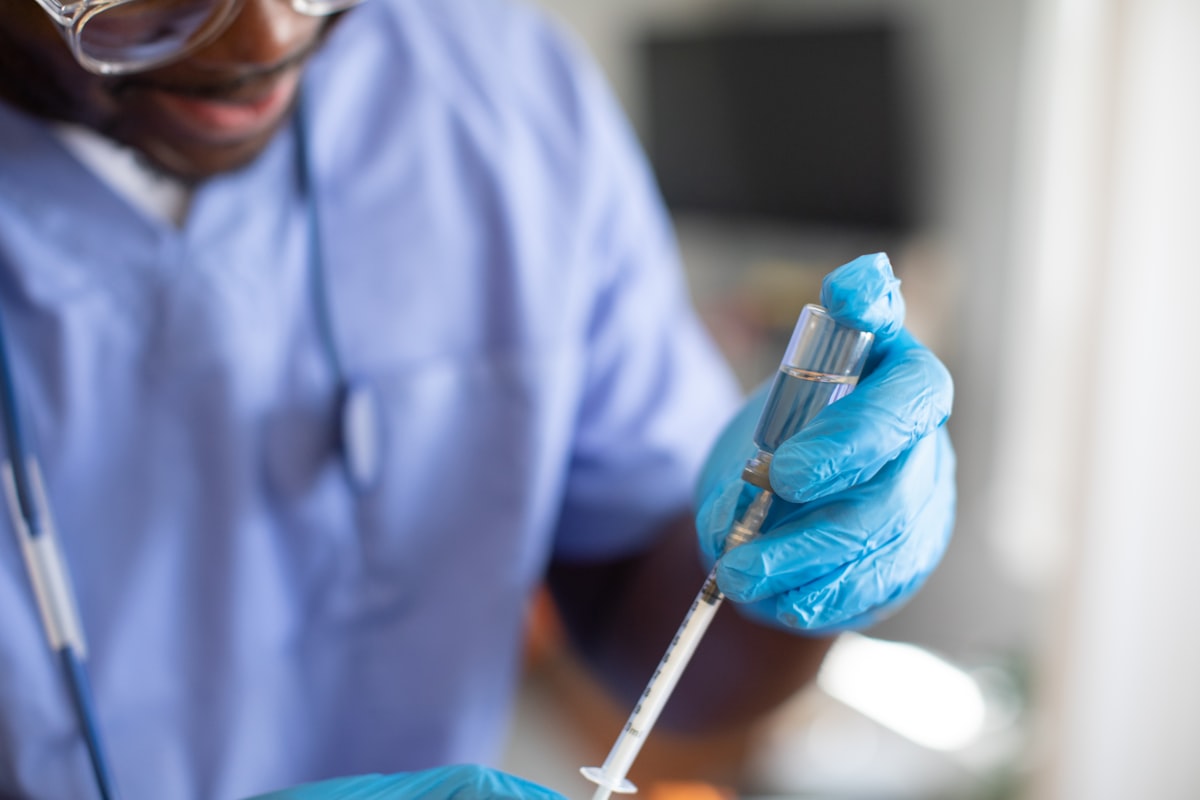
Sermorelin ships as a freeze-dried powder that must be mixed before the first use. The technique follows what the closest approved GHRH analog label specifies.
- Wash your hands and swab both vial stoppers with alcohol
- Draw the exact volume of bacteriostatic water your pharmacy specified. Use only the diluent provided [4]
- Inject the water slowly down the inside wall of the vial rather than directly onto the powder
- Move the vial in a circle to mix the powder and liquid. Do not shake [4]
- Wait until the solution is completely clear before drawing a dose. Do not use it if it stays cloudy or contains particles
- Label the vial with the reconstitution date and the beyond-use date your pharmacy assigned
Do not apply generic refrigeration advice. The EGRIFTA WR label for tesamorelin, the nearest approved GHRH analog, states not to freeze or refrigerate after mixing [4]. Compounded sermorelin formulations differ, and many pharmacies do specify refrigeration. Follow the instructions on your own vial and the beyond-use date assigned under USP 797 [5].
"Reconstituting the Vial" is the kind of detail worth bringing to an actual intake call, not just noting. Embody is our top-ranked provider at $99 a month, with no insurance or bloodwork requirement, prescribed and monitored by licensed clinicians.
Drawing the Correct Dose
The prescription is written in micrograms. The syringe is marked in units. Converting between them is a three-step calculation worth doing on paper the first time.
- Concentration = total micrograms in the vial divided by millilitres of water added
- Volume needed = your prescribed dose in micrograms divided by that concentration
- Units on a U-100 syringe = that volume in millilitres multiplied by 100
| Vial | Water added | Concentration | 200 mcg dose | 300 mcg dose |
|---|---|---|---|---|
| 5 mg | 2 mL | 2500 mcg/mL | 8 units | 12 units |
| 5 mg | 2.5 mL | 2000 mcg/mL | 10 units | 15 units |
| 9 mg | 3 mL | 3000 mcg/mL | 6.7 units | 10 units |
| 15 mg | 5 mL | 3000 mcg/mL | 6.7 units | 10 units |
Draw slightly more than needed, then tap the syringe and push the plunger to expel air bubbles and settle on the exact mark. Air in a subcutaneous injection is not dangerous in these volumes, but it makes the delivered dose inaccurate.
Where to Inject
The abdomen is the primary site. The tesamorelin label directs patients to inject into the abdomen, rotate injection sites to different areas of the abdomen, and avoid scar tissue, bruises, and the navel [4]. General subcutaneous technique also supports the thigh as an alternative site [3]. Confirm site choice with your prescriber rather than assuming.
- Abdomen, at least two inches away from the navel, is the standard site
- Outer thigh is a common alternative under general subcutaneous practice [3]
- Avoid scar tissue, bruised areas, moles, and the navel itself [4]
- Pinch the skin to lift the subcutaneous layer away from muscle if you are lean
Why Site Rotation Is Not Optional
Injecting repeatedly into the same spot causes lipohypertrophy, a thickened area of subcutaneous tissue. This is well documented in the insulin literature, where lipohypertrophy is a frequent complication of therapy that distorts absorption, so injections should not be given into these lesions and correct site rotation will help prevent them [3].
The consequence for a sermorelin protocol is that absorption becomes unpredictable in exactly the tissue you have been using most. A patient whose IGF-1 stalls at the 90-day retest despite good adherence should have their injection sites examined before the dose is raised.
- Divide the abdomen into four quadrants around the navel
- Use one quadrant per week, moving clockwise
- Within a quadrant, place each injection at least one finger-width from the previous one
- Inspect sites monthly for firm or thickened tissue and stop using any area that feels different
Timing: The Part Most People Get Wrong
Inject at bedtime, at least 2 hours after your last meal. Most daily GH release occurs during slow-wave sleep [6], and the published protocols dose at bedtime for that reason [1][2]. Eating shortly before injecting raises blood glucose, which blunts the GH pulse through somatostatin feedback. A correct dose at the wrong time reliably underperforms.
Injection Site Reactions
Local reactions are the most common issue with GHRH analog injections. In the tesamorelin trials, injection site reactions occurred in 25% of treated patients versus 14% on placebo during the first 26 weeks [4]. Mild redness, itching, or a small bump that resolves within a day is expected. Contact your prescriber for reactions that spread, persist beyond 48 hours, or come with signs of infection.
- Let alcohol dry fully before inserting the needle, since injecting through wet alcohol stings
- Use a fresh needle every time. Reused needles are blunt and increase tissue trauma
- Inject at room temperature if your formulation is refrigerated, since cold solution stings more
- Do not massage the site afterward
Injection technique only matters once you have a compounded prescription from a licensed clinician. Embody is our top-ranked provider at $99/month with no insurance or bloodwork required, filled through a compounding pharmacy with dosing guidance included.
Frequently Asked Questions
Where do you inject sermorelin?
Subcutaneously, most commonly into the abdomen at least two inches from the navel. The closest approved GHRH analog label directs injection into the abdomen with rotation between different areas, avoiding scar tissue, bruises, and the navel [4]. The outer thigh is a common alternative under general subcutaneous injection practice [3]. Confirm your site choice with the prescribing physician.
How do I convert my sermorelin dose to syringe units?
Divide the vial's total micrograms by the millilitres of bacteriostatic water added to get concentration, divide your dose by that concentration to get volume in millilitres, then multiply by 100 for units on a U-100 syringe. A 5 mg vial with 2 mL of water gives 2500 mcg/mL, so a 200 mcg dose is 0.08 mL, which is 8 units. Verify your first calculation with the pharmacist.
Should sermorelin be refrigerated after mixing?
It depends on your specific formulation, and generic advice is unreliable here. The EGRIFTA WR label for tesamorelin, the nearest FDA-approved GHRH analog, states not to freeze or refrigerate after reconstitution [4]. Many compounded sermorelin preparations do specify refrigeration. Follow the instructions on your vial and the beyond-use date your compounding pharmacy assigned under USP 797 [5].
What time should I inject sermorelin?
At bedtime, at least 2 hours after eating. Most daily growth hormone release happens during slow-wave sleep [6], and both the pediatric labeling and the adult trial protocol dosed at bedtime [1][2]. Injecting after a recent meal raises blood glucose, which suppresses the GH pulse through somatostatin feedback and can make a correctly measured dose underperform.
Why do I need to rotate injection sites?
Repeated injection into the same area causes lipohypertrophy, a thickened patch of subcutaneous tissue that distorts drug absorption. The insulin injection consensus recommendations state that injections should not be given into these lesions and that correct site rotation helps prevent them [3]. For sermorelin this matters because unpredictable absorption can look like protocol failure at the 90-day IGF-1 retest when the real problem is the tissue.
Does injecting sermorelin hurt?
Usually very little with correct technique. Use the shortest available needle, since 4 mm pen and 6 mm syringe needles are described as safe, effective, and less painful across patient categories [3]. Let the alcohol dry completely before inserting, use a fresh needle each time, and allow refrigerated solution to reach room temperature first. Injection site reactions occurred in 25% of patients versus 14% on placebo in the tesamorelin trials [4], and most are mild and short-lived.
References
- Sermorelin: a review of its use in the diagnosis and treatment of children with idiopathic growth hormone deficiency BioDrugs, 1999. PMID: 18031173. https://pubmed.ncbi.nlm.nih.gov/18031173/
- Endocrine and metabolic effects of long-term administration of [Nle27]growth hormone-releasing hormone-(1-29)-NH2 in age-advanced men and women Journal of Clinical Endocrinology & Metabolism, 1997. PMID: 9141536. https://pubmed.ncbi.nlm.nih.gov/9141536/
- New insulin delivery recommendations Mayo Clinic Proceedings, 2016. PMID: 27594187. https://pubmed.ncbi.nlm.nih.gov/27594187/
- EGRIFTA WR (tesamorelin) for injection, for subcutaneous use: full prescribing information FDA Drugs@FDA, 2025. NDA 022505/S-020. https://www.accessdata.fda.gov/drugsatfda_docs/label/2025/022505s020lbl.pdf
- General Chapter <797> Pharmaceutical Compounding: Sterile Preparations USP, 2023. Official November 1, 2023. https://www.usp.org/compounding/general-chapter-797
- Growth hormone secretion during sleep Journal of Clinical Investigation, 1968. PMID: 5675428. https://pubmed.ncbi.nlm.nih.gov/5675428/