
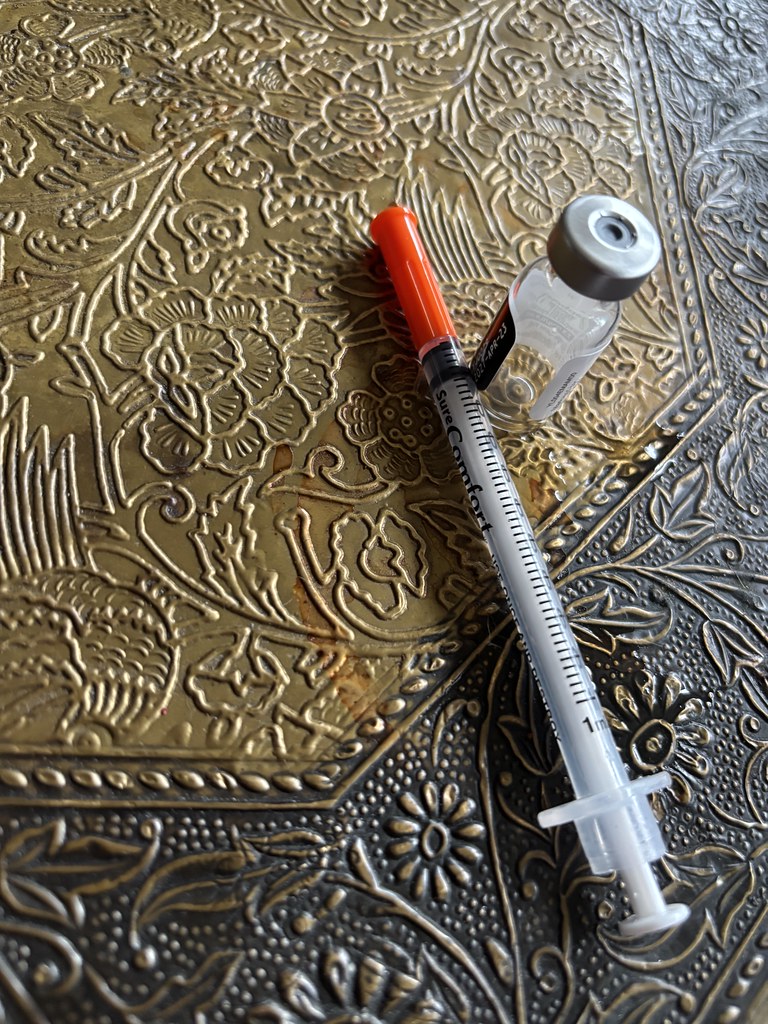
No published human trial has dosed CJC-1295 and ipamorelin together. Everything known about the stack's side effects is built by adding two single-peptide safety records, not by measuring the pair.
CJC-1295 and ipamorelin pairs a long-acting GHRH analog with a selective ghrelin-receptor secretagogue, and the combination is one of the more common protocols built by prescription-based peptide therapy programs. Its side-effect question is less settled than the individual peptides suggest. No study has dosed the two together, so the profile below is assembled from each peptide's own trial record and the FDA's regulatory findings on each, not from a dedicated stack study.
- No published trial has dosed CJC-1295 and ipamorelin together; the profile here is two single-peptide safety records combined, not one study of the pair [1][3]
- CJC-1295 does not act on the ghrelin receptor, so it does not add to ipamorelin's appetite effect. That specific effect does not compound [1][3]
- Fluid retention, joint aches, and reduced glucose tolerance come from raising GH and IGF-1 and apply to both peptides, so a stack that pushes GH higher carries more of that risk than either alone [7]
- FDA has separately flagged both bulk substances for compounding safety risk, citing limited clinical data for CJC-1295 and immunogenicity and serious adverse event reports for ipamorelin [5]
- Ipamorelin's cortisol-sparing selectivity is documented in swine and rats, not people, and CJC-1295 carries FDA-identified serious adverse events including increased heart rate and a systemic vasodilatory reaction [1][5]
- Both peptides are prohibited in sport at all times under the 2026 WADA Prohibited List [8]
| Term | What It Means |
|---|---|
| GHRH analog | A peptide that mimics growth hormone-releasing hormone and signals the pituitary through the GHRH receptor. CJC-1295 is in this class. |
| GH secretagogue | A peptide or drug that triggers a GH pulse through the ghrelin receptor instead of the GHRH receptor. Ipamorelin is in this class. |
| IGF-1 | Insulin-like growth factor 1, the liver-produced lab marker used to measure GH-axis response and set the dose. |
| 503A / 503B pharmacy | The two categories of compounding pharmacy. 503A compounds to an individual prescription; 503B operates under stricter manufacturing standards for batch production. |
The Effects Both Peptides Share
Local injection-site reactions are the most common issue with any subcutaneous GH-axis peptide, and a two-shot protocol simply doubles the number of sites in rotation. Beyond that, the class effects of raising GH and IGF-1 apply regardless of which receptor triggered the pulse. The nearest FDA-approved GHRH analog documents peripheral edema, joint aches, and reduced glucose tolerance as effects of raising GH [7], and both CJC-1295 and ipamorelin carry that caution individually.
- Redness, itching, or a small welt at either injection site, resolving within a day
- Mild fluid retention, most noticeable as puffy hands or ankles
- Joint aches that track with how high the protocol pushes GH and IGF-1
- Reduced glucose tolerance, which matters most for anyone with prediabetes or diabetes
Anyone with prediabetes or diabetes should have fasting glucose checked more often on a stack than on either peptide alone, since two pathways pushing GH higher means more downstream pressure on insulin sensitivity.
What Stacking Actually Changes
The honest answer is that most side effects do not multiply, they add. Ipamorelin's brief rise in appetite comes from binding the same receptor as the hunger hormone ghrelin [3], a mechanism CJC-1295 does not share, so the stack does not produce a larger hunger signal than ipamorelin alone. What does change is the size of the GH pulse itself: pairing a GHRH analog with a ghrelin-receptor secretagogue pushes two separate pituitary pathways at once, and that two-pathway effect is documented in human studies of the individual peptide classes, even without a trial of this specific pair. A larger pulse means the downstream, GH-dependent effects, fluid retention and reduced glucose tolerance, have more room to show up than with a single peptide at a comparable dose.
| Effect | CJC-1295 alone | Ipamorelin alone | Stacked |
|---|---|---|---|
| Appetite change | Not reported in its 2006 trial [1] | Brief rise, ghrelin-receptor mediated [3] | Same as ipamorelin alone; CJC-1295 does not add to it |
| Cortisol / ACTH | Not the mechanism at issue | Spared in animal data, unproven in people [3] | Unchanged from ipamorelin's own profile |
| Fluid retention, glucose tolerance | Class effect of raised GH/IGF-1 [7] | Class effect of raised GH/IGF-1 [7] | Larger combined GH pulse means more room for both |
| Human safety data | One 2006 trial [1][2] | One trial, missed its endpoint [4] | None; inferred from the two above |
The Regulatory Picture for Both Peptides
Separately, not as a pair, both peptides sit on the FDA's list of bulk substances flagged for compounding safety risk [5]. For CJC-1295, FDA cites limited clinical data and identifies increased heart rate and a systemic vasodilatory reaction as serious adverse events. For ipamorelin, FDA cites immunogenicity risk and serious adverse events including death with intravenous use, and in October 2024 an advisory committee voted 0 in favor, 12 against adding it to the 503A compounding list [6]. Neither vote covered CJC-1295 specifically, but neither peptide is an FDA-approved drug, and both are prohibited in sport at all times under WADA section S2.2.4 [8].
How a Stacked Protocol Manages the Combined Risk
The discipline that controls risk on a single peptide controls it on a stack, just with a lower margin for error. A baseline IGF-1 draw before starting either peptide establishes the number a prescriber is working from. A 90-day retest shows whether the combined pulse pushed IGF-1 above the age-adjusted range, which is the signal to reduce dose rather than add a third agent. Fasting glucose belongs in that same retest for anyone with a metabolic risk factor.
The pharmacy is the other variable a stack does not change. Compounded peptides are not FDA-verified for quality before sale, so ask which pharmacy fills each vial and whether a Certificate of Analysis is available. A program that combines two agents without a baseline lab has taken on twice the uncertainty with none of the measurement to manage it.
Stacking CJC-1295 and ipamorelin without a starting IGF-1 means guessing at a combined dose with no way to check the result. SystemLabs tests IGF-1 before prescribing and formulates CJC-1295 and ipamorelin stacks on clinical indication, so the combined dose is set against your labs and retested at 90 days.
Frequently Asked Questions
What are the side effects of the CJC-1295 and ipamorelin stack?
The common ones are local injection-site reactions at both sites, mild fluid retention, joint aches, and reduced glucose tolerance, all class effects of raising GH and IGF-1 [7]. Ipamorelin adds a brief, transient rise in appetite that CJC-1295 does not share or add to [3]. Neither peptide has a published trial of the two dosed together, so the profile is inferred rather than directly measured.
Do CJC-1295 and ipamorelin side effects add up when stacked?
Some do and some do not. Appetite change comes only from ipamorelin's ghrelin-receptor activity and does not compound with CJC-1295 [1][3]. Fluid retention and reduced glucose tolerance are class effects of raised GH and IGF-1 that both peptides contribute to, so a stack that produces a larger combined pulse carries more of that specific risk than either peptide alone.
Is the CJC-1295 and ipamorelin stack safe?
Its safety is not independently established. Each peptide individually sits on the FDA's list of bulk substances flagged for compounding safety risk, and an advisory committee voted against adding ipamorelin to the approved 503A list [5][6]. A stack built on a baseline IGF-1 and a 90-day retest is the more carefully managed version, but neither peptide is FDA-approved and no combined-dose trial exists.
Does stacking CJC-1295 and ipamorelin cause more water retention than either alone?
It can, because both peptides raise GH and IGF-1 through separate receptor pathways, and the combined pulse can push higher than either peptide produces on its own [7]. Mild puffiness in the hands or ankles is the usual presentation, and it tends to ease at a lower combined dose.
Can you take CJC-1295 and ipamorelin together if you have diabetes?
This is a conversation for a prescriber managing your glucose closely, not a decision to make alone. Raising GH reduces insulin sensitivity as a class effect [7], and a two-pathway stack has more room to push glucose than a single peptide. Fasting glucose should be part of the same lab panel used for the baseline and 90-day IGF-1 checks.
References
- Prolonged stimulation of growth hormone (GH) and insulin-like growth factor I secretion by CJC-1295, a long-acting analog of GH-releasing hormone, in healthy adults Journal of Clinical Endocrinology & Metabolism, 2006. PMID: 16352683. https://pubmed.ncbi.nlm.nih.gov/16352683/
- Pulsatile secretion of growth hormone (GH) persists during continuous stimulation by CJC-1295, a long-acting GH-releasing hormone analog Journal of Clinical Endocrinology & Metabolism, 2006. PMID: 17018654. https://pubmed.ncbi.nlm.nih.gov/17018654/
- Ipamorelin, the first selective growth hormone secretagogue European Journal of Endocrinology, 1998. PMID: 9849822. https://pubmed.ncbi.nlm.nih.gov/9849822/
- Prospective, randomized, controlled, proof-of-concept study of the ghrelin mimetic ipamorelin for the management of postoperative ileus in bowel resection patients International Journal of Colorectal Disease, 2014. PMID: 25331030. https://pubmed.ncbi.nlm.nih.gov/25331030/
- Certain bulk drug substances for use in compounding that may present significant safety risks FDA.gov, Human Drug Compounding, 2026. Content current as of 04/22/2026. https://www.fda.gov/drugs/human-drug-compounding/certain-bulk-drug-substances-use-compounding-may-present-significant-safety-risks
- Summary minutes of the Pharmacy Compounding Advisory Committee meeting, October 29, 2024 FDA Advisory Committee, 2024. PCAC summary minutes. https://www.fda.gov/media/185412/download
- EGRIFTA SV (tesamorelin) for injection: full prescribing information DailyMed, U.S. National Library of Medicine, 2025. FDA-approved labeling. https://dailymed.nlm.nih.gov/dailymed/drugInfo.cfm?setid=3d783378-b02d-4f19-99dd-0fc91a042224
- The 2026 Prohibited List: International Standard, section S2.2.4 growth hormone releasing factors World Anti-Doping Agency, 2026. WADA 2026 Prohibited List. https://www.wada-ama.org/en/resources/2026-prohibited-list