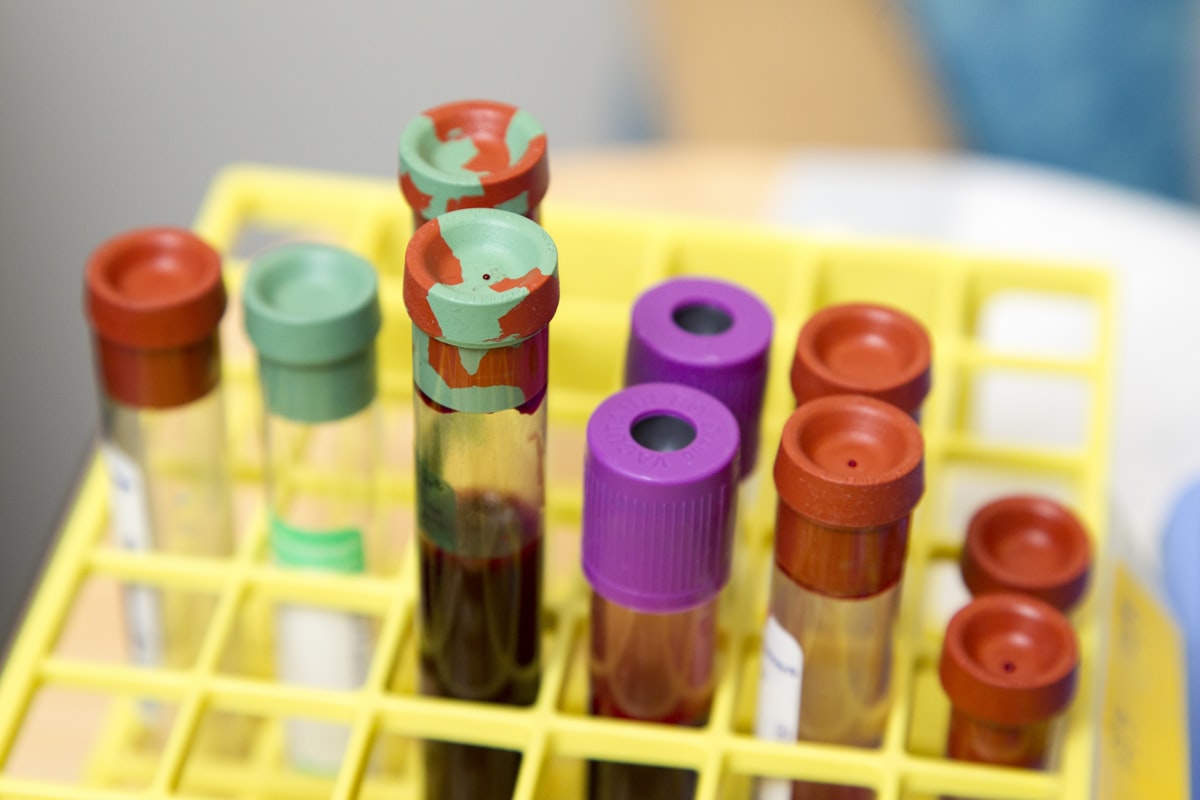

Tesamorelin and ipamorelin are not rivals. Tesamorelin is a GHRH analog with FDA approval and phase 3 trials. Ipamorelin is a secretagogue that works on a different receptor and is used as a stack partner. Comparing them is really a comparison of two mechanisms with very different evidence behind them.
Tesamorelin and ipamorelin are both used to raise growth hormone, but they are not the same class of drug and they are not backed by the same quality of evidence. Tesamorelin is a GHRH analog with FDA approval and large phase 3 trials [1][2]. Ipamorelin is a growth hormone secretagogue with a clean side-effect profile and almost no efficacy data of its own [5][6]. They answer different questions.
- Tesamorelin is a GHRH analog. It binds the GHRH receptor on the pituitary [1]
- Ipamorelin is a ghrelin-receptor secretagogue. It binds a different receptor entirely [5]
- Tesamorelin is FDA-approved for HIV-associated lipodystrophy and has phase 3 trials showing a 15.2% visceral fat reduction [1][2]
- Ipamorelin's only efficacy trial targeted postoperative ileus, did not reach significance, and development stopped [6]
- Ipamorelin's selling point is selectivity: it raises GH without raising cortisol or prolactin [5]
- Neither is FDA-approved for anti-aging or muscle building
Two Different Receptors
The mechanistic split is the whole comparison. Tesamorelin is a stabilized analog of growth hormone-releasing hormone. It binds the GHRH receptor on the anterior pituitary and drives GH release the way the body's own GHRH does [1].
Ipamorelin works on the other GH-release pathway. It is a selective growth hormone secretagogue that acts on the ghrelin receptor, a separate control point from GHRH [5]. Because the two act on different receptors, their signals add. In humans, GHRH and a secretagogue given together produced a GH response far larger than the sum of each alone [7].
This is why the two are complements more than competitors. Tesamorelin is a GHRH-side drug. Ipamorelin is a secretagogue-side drug. Comparing them is really a comparison of two mechanisms with very different evidence behind them.
The Evidence Gap
This is the largest practical difference, and it is not close. Tesamorelin was studied in large randomized placebo-controlled phase 3 programs because it went through FDA approval. Ipamorelin never completed that path for any body-composition use.
Tesamorelin data
In a 412-patient trial over 26 weeks, visceral adipose tissue fell 15.2% with tesamorelin versus a 5.0% increase on placebo, and IGF-1 rose 81.0% [2]. A pooled analysis of 806 patients found a 15.4% treatment effect on visceral fat at 26 weeks, extending to 17.5% at 52 weeks [3]. The effect is real and measured, and it is reversible: visceral fat reaccumulated after treatment stopped [4].
Ipamorelin data
Ipamorelin has nothing comparable. Its defining study established selectivity, not body composition: ipamorelin released GH without raising ACTH or cortisol above GHRH-stimulated levels, even at doses more than 200 times its GH ED50 [5]. Its only published efficacy trial targeted postoperative ileus and found a median time to first tolerated meal of 25.3 hours versus 32.6 on placebo, which did not reach statistical significance. Development was discontinued [6].
So the honest summary is lopsided. Tesamorelin has phase 3 body-composition endpoints. Ipamorelin has a strong safety-selectivity profile and no efficacy endpoint for the uses people actually want it for.
That gap does not make ipamorelin useless. It means its case is mechanistic rather than outcome-proven. A provider offering ipamorelin is betting that a selective GH pulse, added to a GHRH analog, translates into the body-composition changes tesamorelin demonstrated directly. That is a reasonable bet, not a proven one, and honest copy should say so.
| Property | Tesamorelin | Ipamorelin |
|---|---|---|
| Drug class | GHRH analog [1] | GH secretagogue, ghrelin receptor [5] |
| Receptor | GHRH receptor | Ghrelin / GHS receptor |
| FDA status | Approved for HIV lipodystrophy [1] | Not FDA-approved |
| Best evidence | Phase 3 trials, 15.2% visceral fat drop [2] | Selectivity data; no positive efficacy trial [5][6] |
| Cortisol / prolactin | Not its selling point | Does not raise either [5] |
| Typical use | Visceral fat, monotherapy | Stack partner with a GHRH analog [7] |
| Anti-aging approval | None | None |
Side Effects and Selectivity
Ipamorelin's advantage is what it does not do. Older secretagogues like GHRP-6 and GHRP-2 raise cortisol and prolactin. Ipamorelin does not, which is why it became the preferred secretagogue for stacking [5]. For someone building a protocol, that clean profile is the whole appeal.
Tesamorelin's watch-item is metabolic. Growth hormone opposes insulin, so glucose deserves monitoring on any GHRH-side therapy. The pooled phase 3 data was reassuring, with an early modest rise in HbA1c that resolved and no meaningful glucose difference by 52 weeks [3][8]. Patients with diabetes or impaired fasting glucose should still have glucose checked during the first 3 months.
Cost and Access
Tesamorelin is a commercial specialty product priced accordingly, and its approval is narrow: excess abdominal fat in HIV-associated lipodystrophy in adults [1]. Using it for general body composition is off-label and expensive.
Ipamorelin is not an approved finished drug. It reaches patients as a compounded peptide, usually paired with a GHRH analog like sermorelin or CJC-1295. Quality then depends on the compounding pharmacy, which is why 503A versus 503B sourcing and USP 797 sterility standards decide whether a given vial is worth using.
That difference shapes what telehealth platforms dispense. You will rarely see tesamorelin on a wellness subscription, because its price and narrow label do not fit that model. What you see instead is a GHRH analog like sermorelin or CJC-1295 paired with ipamorelin, sold as a compounded monthly protocol. The comparison most readers face is not tesamorelin against ipamorelin. It is a GHRH-plus-secretagogue stack against a specialty drug they will probably never be prescribed.
The Honest Verdict
For evidence, tesamorelin wins outright. It has phase 3 trials, a measured visceral-fat effect, and an FDA approval, none of which ipamorelin can claim [1][2][6]. If your goal is documented visceral-fat reduction and you fit the indication, tesamorelin is the researched choice.
For real-world telehealth use, the comparison is less of a contest than it looks. Ipamorelin is not trying to be a standalone visceral-fat drug. It is the secretagogue you add to a GHRH analog for a larger, cleaner GH pulse [5][7]. Most people choosing between these are really choosing between a narrow specialty product and a stack component.
Neither is FDA-approved for anti-aging, muscle building, or general weight loss. Both belong in a protocol with a baseline IGF-1 and a 90-day retest, because the only way to judge either one is the marker it moves.
Ipamorelin is a stack component, not a solo act, and it belongs with a GHRH analog and real IGF-1 monitoring. SystemLabs offers clinician-guided peptide protocols including sermorelin with ipamorelin, sourced from licensed U.S. pharmacies.
Frequently Asked Questions
Is tesamorelin or ipamorelin better?
For evidence, tesamorelin. It is FDA-approved for HIV-associated lipodystrophy and has phase 3 trials showing a 15.2% visceral-fat reduction [1][2]. Ipamorelin has a clean selectivity profile but no positive efficacy trial for body composition [5][6]. They are not really rivals: tesamorelin is a GHRH analog, and ipamorelin is a secretagogue used as a stack partner.
Can you take tesamorelin and ipamorelin together?
Mechanistically it makes sense, because they act on different receptors and their GH signals add [7]. In practice, ipamorelin is usually paired with a shorter GHRH analog like sermorelin or CJC-1295 rather than with tesamorelin, which is a costly specialty product. Any combination should run under IGF-1 monitoring.
Does ipamorelin build more muscle than tesamorelin?
No study supports that claim for either drug. Tesamorelin's measured endpoint is visceral fat, not muscle [2], and ipamorelin has no positive body-composition trial at all [6]. Both raise GH and IGF-1, which supports lean mass indirectly, but neither has a randomized muscle-growth result.
Is ipamorelin safer than tesamorelin?
They carry different considerations. Ipamorelin's strength is selectivity: it raises GH without raising cortisol or prolactin [5]. Tesamorelin's watch-item is glucose, though pooled phase 3 data showed no meaningful difference by 52 weeks [3]. Ipamorelin is compounded rather than FDA-approved, so its real variable is pharmacy quality.
Is either one FDA approved?
Only tesamorelin, and only for one indication: reducing excess abdominal fat in HIV-infected adults with lipodystrophy [1]. Ipamorelin is not FDA-approved and reaches patients as a compounded peptide. Neither is approved for anti-aging, muscle building, or general weight loss.
Why is ipamorelin used if it has no efficacy trials?
Its value is selectivity and its role in a stack, not standalone results. Ipamorelin adds a secretagogue signal that combines with a GHRH analog to produce a larger GH pulse than either alone [7], and it does so without the cortisol and prolactin rise seen with older secretagogues [5]. The rationale is mechanistic; the body-composition endpoint has not been trialed.
References
- EGRIFTA SV (tesamorelin) for injection, for subcutaneous use: full prescribing information DailyMed, U.S. National Library of Medicine, 2010. Initial U.S. Approval: 2010. https://dailymed.nlm.nih.gov/dailymed/drugInfo.cfm?setid=3d783378-b02d-4f19-99dd-0fc91a042224
- Metabolic effects of a growth hormone-releasing factor in patients with HIV New England Journal of Medicine, 2007. PMID: 18057338. https://pubmed.ncbi.nlm.nih.gov/18057338/
- Effects of tesamorelin (TH9507), a growth hormone-releasing factor analog, in HIV-infected patients with excess abdominal fat: a pooled analysis of two multicenter, double-blind placebo-controlled phase 3 trials with safety extension data Journal of Clinical Endocrinology & Metabolism, 2010. PMID: 20554713. https://pubmed.ncbi.nlm.nih.gov/20554713/
- Effects of tesamorelin, a growth hormone-releasing factor, in HIV-infected patients with abdominal fat accumulation: a randomized placebo-controlled trial with a safety extension Journal of Acquired Immune Deficiency Syndromes, 2010. PMID: 20101189. https://pubmed.ncbi.nlm.nih.gov/20101189/
- Ipamorelin, the first selective growth hormone secretagogue European Journal of Endocrinology, 1998. PMID: 9849822. https://pubmed.ncbi.nlm.nih.gov/9849822/
- Prospective, randomized, controlled, proof-of-concept study of the ghrelin mimetic ipamorelin for the management of postoperative ileus in bowel resection patients International Journal of Colorectal Disease, 2014. PMID: 25331030. https://pubmed.ncbi.nlm.nih.gov/25331030/
- Growth hormone (GH) secretion in active acromegaly after the combined administration of GH-releasing hormone and GH-releasing peptide-6 Journal of Clinical Endocrinology & Metabolism, 1994. PMID: 8045963. https://pubmed.ncbi.nlm.nih.gov/8045963/
- Effects of growth hormone-releasing hormone on visceral fat, metabolic, and cardiovascular indices in human studies Growth Hormone & IGF Research, 2015. PMID: 25555516. https://pubmed.ncbi.nlm.nih.gov/25555516/