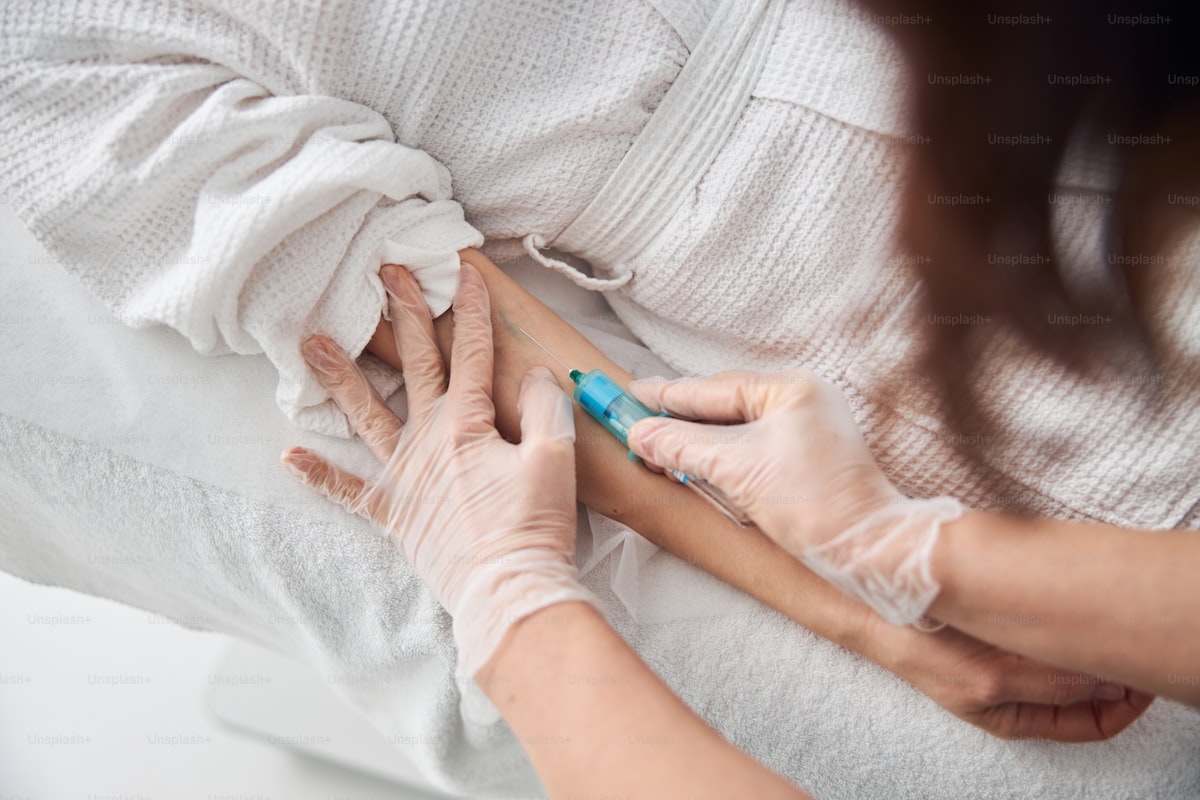

The FDA label dose for tesamorelin is a single fixed number, 2 mg once daily, and it was set for one population only. There is no weight-based tesamorelin dose and no self-titration schedule, because the drug was studied and approved for HIV-associated lipodystrophy under physician supervision.
The FDA label dose for tesamorelin is 2 mg injected subcutaneously once daily [1]. That figure is fixed, not weight-based, and it was set for one approved population: HIV-infected adults with lipodystrophy. This guide explains the label dose, why it requires a prescribing physician rather than a calculator, the monitoring that goes with it, and where compounded sermorelin fits for age-related GH decline.
- FDA label dose: 2 mg subcutaneously once daily, into the abdomen [1]
- The dose is fixed, not adjusted by body weight, and there is no titration schedule
- It is approved for HIV-associated lipodystrophy only; any other use is off-label [1]
- IGF-1 and glucose monitoring accompany treatment [1][5]
- For age-related GH decline, compounded sermorelin at 100 to 300 mcg nightly is what telehealth actually prescribes [7]
The dose below is FDA label reference information for one approved condition. It is not a prescription and not a self-dosing template. Tesamorelin outside HIV-associated lipodystrophy is off-label, priced as a specialty product, and dispensed only through a prescribing physician. Do not self-source or self-dose peptides.
The FDA Label Dose
Tesamorelin is supplied as a lyophilized powder that is reconstituted before injection. The approved regimen is one 2 mg dose per day, given subcutaneously into the abdomen, with injection sites rotated to limit local reactions [1]. It is a once-daily drug because the DPP-4-resistant structure sustains the GH signal across the day, unlike the shorter GHRH fragments that clear within minutes.
| Parameter | FDA label | Notes |
|---|---|---|
| Dose | 2 mg once daily [1] | Fixed, not weight-based |
| Route | Subcutaneous [1] | Into the abdomen, rotate sites |
| Timing | Once daily [1] | Consistent time each day |
| Approved population | HIV lipodystrophy, adults [1] | Off-label outside this group |
| Form | Reconstituted lyophilized powder [1] | Prepared per label instructions |
Why This Is Not a Self-Dosing Number
A single approved dose can look like an invitation to self-administer. It is not, for three reasons. The dose was validated in one supervised patient population, the drug carries contraindications and monitoring requirements, and the products sold outside a pharmacy channel are not the FDA-approved article.
- The 2 mg figure was studied in HIV-infected adults with lipodystrophy, not the general population [2]
- Growth hormone opposes insulin, so glucose has to be watched during treatment [5]
- IGF-1 is monitored to confirm the axis is responding without overshooting [1]
- Tesamorelin sold outside a licensed pharmacy is unverified for identity, potency, and sterility
A prescribing physician sets and supervises the dose against your labs and history. That is the difference between a validated therapy and a guess.
What the 2 mg Dose Was Studied to Do
At the label dose, the trial results are consistent. A 412-patient study found visceral adipose tissue fell 15.2% at 26 weeks versus a 5.0% increase on placebo, with IGF-1 rising 81.0% [2]. A pooled analysis of 806 patients found a 15.4% visceral fat treatment effect at 26 weeks, extending to 17.5% at 52 weeks [3]. A separate 404-patient trial reported 10.9% at 6 months, with reaccumulation after the drug was stopped [4].
Visceral fat reaccumulated after tesamorelin was discontinued [4]. Response depends on continued dosing, which is part of why this is a physician-managed therapy rather than a short self-directed course.
Monitoring That Goes With the Dose
The dose is only half of the protocol. Tesamorelin therapy includes laboratory follow-up because the GH axis it drives has metabolic consequences worth tracking.
- Baseline IGF-1 before starting, so response can be measured against a real starting point
- IGF-1 during treatment to confirm the axis is responding without pushing above the age-adjusted range [1]
- Glucose and HbA1c, since GH opposes insulin and an early rise can appear before settling [5]
- Ongoing assessment of whether the approved indication still applies
The glucose signal is manageable rather than alarming. Reviews describe a modest early rise in HbA1c that was no longer evident by 52 weeks [5], indicating neutrality over a full course. Patients with diabetes or impaired fasting glucose still warrant closer monitoring in the first 3 months.
The Compounded Sermorelin Alternative
Most people searching tesamorelin dosing are not candidates for the approved indication. They are looking at GHRH therapy for age-related GH decline, and the drug that telehealth platforms actually dispense for that is compounded sermorelin, not tesamorelin.
Sermorelin is the shorter GHRH(1-29) fragment [7] and is dosed differently: nightly at bedtime, in a range of 100 to 300 mcg, set by a prescribing physician and titrated against a 90-day IGF-1 retest. The closest published adult reference used 10 mcg/kg subcutaneously nightly [6], though most telehealth protocols start well below that and adjust on lab response. Sermorelin is compounded rather than FDA-approved, so pharmacy sourcing and USP 797 sterility standards matter.
Tesamorelin is a specialty drug for one approved condition. For age-related GH decline, the practical GHRH-analog option is compounded sermorelin, dosed nightly and titrated against IGF-1. SystemLabs includes baseline IGF-1 testing before prescribing, so the dose is set against your own number rather than a generic figure.
Bottom Line
Frequently Asked Questions
What is the standard dose of tesamorelin?
The FDA label dose is 2 mg injected subcutaneously once daily into the abdomen [1]. It is a fixed dose rather than a weight-based one, and it was approved for HIV-infected adults with lipodystrophy. Any use outside that indication is off-label and set by a prescribing physician, not by a calculator.
Is tesamorelin dosed by body weight?
No. Unlike sermorelin, whose closest adult reference dose was weight-based at 10 mcg/kg [6], tesamorelin's approved dose is a fixed 2 mg once daily regardless of body weight [1]. There is no published weight-based tesamorelin schedule and no validated self-titration protocol.
Can I take tesamorelin for weight loss at the label dose?
Tesamorelin is approved only for reducing excess abdominal fat in HIV-infected adults with lipodystrophy [1]. Using it for general weight loss is off-label, and its trials targeted visceral fat specifically rather than overall body weight [2]. It is also priced as a specialty product and requires physician oversight and lab monitoring.
How long until the tesamorelin dose works?
The trial endpoints were measured at 26 weeks and 52 weeks, with visceral fat reductions of roughly 15 to 17% over those windows [2][3]. IGF-1 rises earlier and is the biomarker used to confirm the axis is responding [2]. Like other GHRH-axis therapies, tesamorelin builds over months, and visceral fat reaccumulates once it is stopped [4].
What monitoring is needed on tesamorelin?
IGF-1 is monitored to confirm the axis is responding without exceeding the age-adjusted range [1], and glucose and HbA1c are watched because growth hormone opposes insulin [5]. Reviews describe a modest early HbA1c rise that resolved by 52 weeks [5]. Patients with diabetes or impaired fasting glucose need closer monitoring in the first 3 months.
What is the sermorelin equivalent dose?
There is no direct equivalence, because they are different molecules with different clearance. Sermorelin is dosed nightly at bedtime, commonly 100 to 300 mcg set by a prescribing physician, with the closest published adult reference at 10 mcg/kg nightly [6]. Sermorelin is the compounded GHRH(1-29) fragment used off-label for age-related GH decline [7], and its dose is titrated against a 90-day IGF-1 retest.
References
- EGRIFTA SV (tesamorelin) for injection, for subcutaneous use: full prescribing information DailyMed, U.S. National Library of Medicine, 2010. Initial U.S. Approval: 2010. https://dailymed.nlm.nih.gov/dailymed/drugInfo.cfm?setid=3d783378-b02d-4f19-99dd-0fc91a042224
- Metabolic effects of a growth hormone-releasing factor in patients with HIV New England Journal of Medicine, 2007. PMID: 18057338. https://pubmed.ncbi.nlm.nih.gov/18057338/
- Effects of tesamorelin (TH9507), a growth hormone-releasing factor analog, in HIV-infected patients with excess abdominal fat: a pooled analysis of two multicenter, double-blind placebo-controlled phase 3 trials with safety extension data Journal of Clinical Endocrinology & Metabolism, 2010. PMID: 20554713. https://pubmed.ncbi.nlm.nih.gov/20554713/
- Effects of tesamorelin, a growth hormone-releasing factor, in HIV-infected patients with abdominal fat accumulation: a randomized placebo-controlled trial with a safety extension Journal of Acquired Immune Deficiency Syndromes, 2010. PMID: 20101189. https://pubmed.ncbi.nlm.nih.gov/20101189/
- Effects of growth hormone-releasing hormone on visceral fat, metabolic, and cardiovascular indices in human studies Growth Hormone & IGF Research, 2015. PMID: 25555516. https://pubmed.ncbi.nlm.nih.gov/25555516/
- Endocrine and metabolic effects of long-term administration of [Nle27]growth hormone-releasing hormone-(1-29)-NH2 in age-advanced men and women Journal of Clinical Endocrinology & Metabolism, 1997. PMID: 9141536. https://pubmed.ncbi.nlm.nih.gov/9141536/
- Sermorelin: a review of its use in the diagnosis and treatment of children with idiopathic growth hormone deficiency BioDrugs, 1999. PMID: 18031173. https://pubmed.ncbi.nlm.nih.gov/18031173/