
Ipamorelin has no trial-established dose for the uses it is now sold for. Its clinical development targeted postoperative bowel recovery, and that program stopped after the one published efficacy trial missed its endpoint.
Ipamorelin dosing has no number that comes from a trial for the uses it is now sold for. Its clinical development targeted postoperative bowel recovery, not body composition, and that program stopped after the one published efficacy trial missed its endpoint [3]. What can be stated is structural. Ipamorelin is short-acting, dosed for a single pulse, and almost always given alongside a GHRH analog rather than alone.
- Ipamorelin has no trial-established dose for body composition or anti-aging; any protocol is physician-determined and off-label
- It acts on the ghrelin receptor and is short-acting, contributing a short GH pulse rather than sustained elevation [1]
- It is dosed subcutaneously, usually at bedtime on an empty stomach, to align the pulse with natural nocturnal GH release
- It is dosed alongside a GHRH analog such as sermorelin or CJC-1295, because a single pathway leaves the supra-additive effect unused [2]
- A baseline IGF-1 before starting and a retest at about 90 days are what make a dose measurable
- An FDA advisory committee voted 0 in favor and 12 against permitting ipamorelin for compounding; it is prohibited in sport at all times [4][5]
Why Ipamorelin Is Dosed Alongside a GHRH Analog
The most important fact about ipamorelin dosing is that the dose is rarely a solo one. Ipamorelin works through the ghrelin receptor, a separate pathway from the GHRH receptor that sermorelin and CJC-1295 use [1]. Pushing both pathways produces more GH than pushing either alone.
That is measured, not theoretical. In healthy people, GH area under the curve was 686 for GHRH alone, 1787 for a secretagogue alone, and 4111 for the two together, well above the sum [2]. The study used GHRP-6 rather than ipamorelin, so the exact magnitude is an extrapolation, but the direction holds. A solo ipamorelin dose leaves the main reason to use it on the table.
Subcutaneous Timing: Bedtime, Empty Stomach
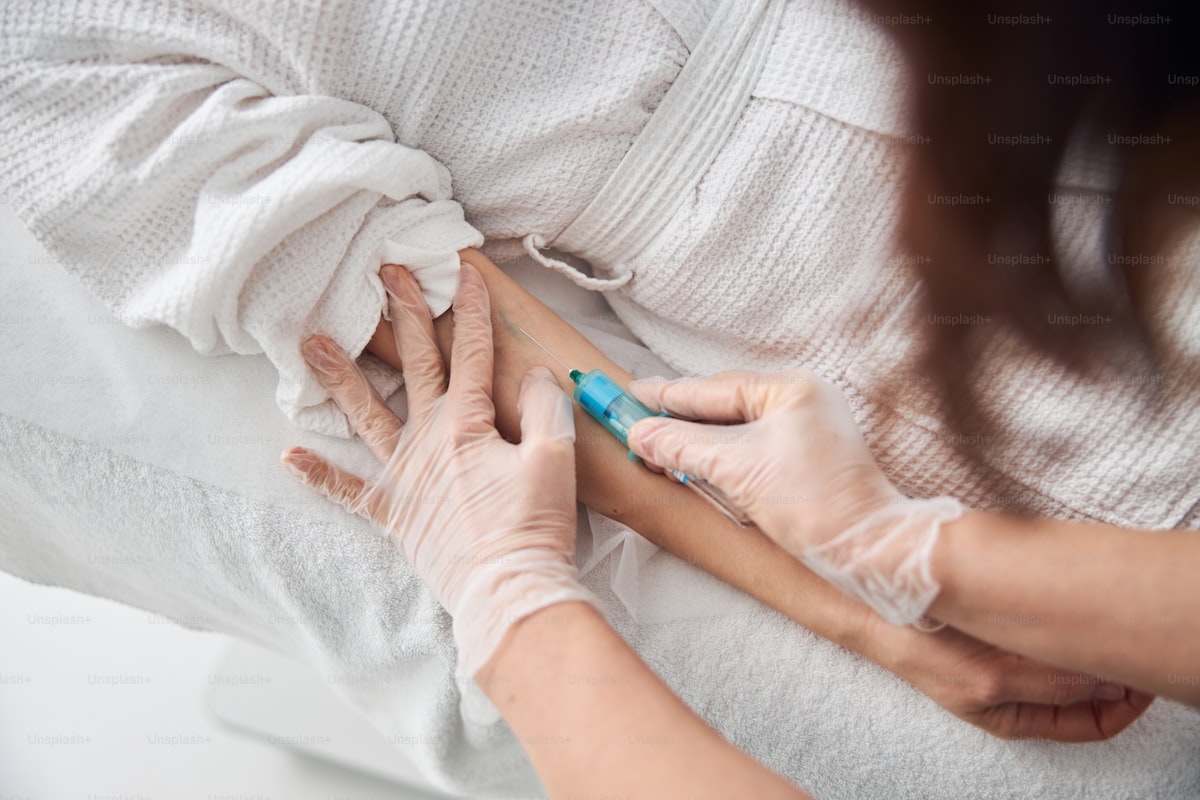
Ipamorelin is injected subcutaneously, and timing matters more than most charts convey. Because it is short-acting and produces a brief pulse [1], it is dosed at bedtime to align that pulse with the body's natural post-sleep-onset GH release. A pulse delivered on top of the nightly rhythm the GH axis already runs is closer to physiologic than one dropped in at midday.
It is given on an empty stomach, with food avoided for roughly two hours before, because circulating nutrients blunt the GH response. The same bedtime, fasting logic applies to the GHRH analog it is paired with, which is why the two are usually injected together at night.
Frequency and the Short Pulse
Ipamorelin's short duration sets its frequency. It does not linger the way CJC-1295 with DAC does, which has a half-life of 5.8 to 8.1 days [6]. Where a long-acting GHRH analog can be dosed weekly, ipamorelin is dosed daily, once at night and in some protocols split into more than one pulse.
More frequent is not the same as higher. Each dose is a single pulse, and stacking extra pulses into a day does not reproduce the sustained elevation of a long-acting peptide. It reproduces more short pulses, which is a different thing, and one no trial has optimized for the uses ipamorelin is sold for.
The Dose Itself Is Physician-Determined
The actual dose belongs to a prescribing physician working from your labs, set off-label because ipamorelin has no approved product to label. A baseline IGF-1 is drawn before the first injection. Without it there is no reference point to tell whether the dose is doing anything.
IGF-1 is retested at about 90 days, the point where the response is expected to plateau. A result above the age-adjusted range is a reason to lower the dose. The canonical anchor is the GHRH analog it accompanies: sermorelin at 100 to 300 mcg per day subcutaneously at bedtime, titrated by retest rather than by feel. Ipamorelin is the addition to that base, adjusted the same way.
The Safety Ceiling and the Red Flags
The ceiling on ipamorelin is set by IGF-1 and by symptoms, not by the vial. Water retention, joint stiffness, and carpal-tunnel-type tingling are the familiar signs of too much GH activity, and they resolve when the dose comes down. They are a reason to retest, not to push through.
The selectivity that makes ipamorelin attractive is real but shown in animals. In swine and rats it raised GH without raising cortisol or ACTH even at more than 200 times its GH threshold, unlike older secretagogues [1]. Treat the cortisol advantage as strongly suggested by animal data rather than proven in people.
The regulatory standing belongs in the decision. FDA lists ipamorelin acetate among bulk substances flagged as a compounding safety risk, and its Pharmacy Compounding Advisory Committee voted 0 in favor and 12 against permitting it for compounding in October 2024 [4][5]. It is named on the 2026 WADA Prohibited List, prohibited at all times [7].
A program that sets an ipamorelin dose without a baseline IGF-1, or that dispenses it as a solo protocol with no GHRH analog, is not following the evidence that makes the peptide worth using. A fixed dose identical for every patient is a marketing number, not a clinical one.
The Honest Verdict
Ipamorelin has no trial dose for the reasons people take it, so the honest guidance is structural rather than numeric. It is short-acting, dosed at bedtime on an empty stomach, given alongside a GHRH analog, and titrated against IGF-1. The dose that matters is the one a prescriber builds from your labs.
The discipline is the same as for any GH-axis therapy. Draw a baseline IGF-1 first. Establish that a GHRH analog moves that number into range over 90 days, and add ipamorelin as the second pathway rather than the first. A provider that sets a dose without the baseline draw is the red flag, whether the vial holds one peptide or two.
Ipamorelin has no trial dose and works best layered onto a GHRH analog, which makes a starting IGF-1 and a 90-day retest the part that turns a protocol into something measurable. SystemLabs tests IGF-1 before prescribing and formulates ipamorelin alongside a GHRH analog on clinical indication, so the dose is built from your labs rather than a fixed chart.
Frequently Asked Questions
What is the correct dose of ipamorelin?
There is no trial-established dose of ipamorelin for body composition or anti-aging, because its clinical development targeted postoperative ileus and stopped after the one published trial missed its endpoint [3]. Any protocol is physician-determined and off-label, set by a prescriber from a baseline IGF-1 rather than from a vendor chart.
When is the best time to take ipamorelin?
At bedtime, on an empty stomach. Ipamorelin is short-acting and produces a brief GH pulse [1], so dosing it at night aligns that pulse with the body's natural post-sleep-onset GH release. Food within about two hours blunts the GH response, which is why it is dosed fasting.
How often should ipamorelin be dosed?
Daily, because it is short-acting and does not linger the way a long-acting peptide does. It is usually dosed once at night, and some protocols split it into more than one pulse [1]. Adding extra pulses does not reproduce the sustained elevation of a long-acting GHRH analog; it only adds more short pulses.
Should ipamorelin be taken alone or with sermorelin?
With a GHRH analog such as sermorelin or CJC-1295. Ipamorelin acts on the ghrelin receptor, a separate pathway, and a GHRH analog plus a secretagogue produced a GH response well above the sum of each alone in humans [2]. A solo ipamorelin dose leaves that supra-additive effect unused, which is why it is rarely run by itself.
Do you need labs to dose ipamorelin?
Yes. A responsible protocol starts from a baseline IGF-1 drawn before the first injection, then retests at about 90 days to see whether the dose moved the number into the age-adjusted range. A program that sets a dose without that baseline has skipped the one step that makes the dose measurable.
Is there a maximum safe dose of ipamorelin?
The ceiling is set by IGF-1 and by symptoms, not by a fixed milligram number. An IGF-1 above the age-adjusted range at the 90-day retest is a reason to lower the dose, and water retention, joint stiffness, or carpal-tunnel-type tingling are signs of too much GH activity that resolve when the dose comes down. FDA also flags ipamorelin acetate as a compounding safety risk [4].
References
- Ipamorelin, the first selective growth hormone secretagogue European Journal of Endocrinology, 1998. PMID: 9849822. https://pubmed.ncbi.nlm.nih.gov/9849822/
- Growth hormone (GH) secretion in active acromegaly after the combined administration of GH-releasing hormone and GH-releasing peptide-6 Journal of Clinical Endocrinology & Metabolism, 1994. PMID: 8045963. https://pubmed.ncbi.nlm.nih.gov/8045963/
- Prospective, randomized, controlled, proof-of-concept study of the ghrelin mimetic ipamorelin for the management of postoperative ileus in bowel resection patients International Journal of Colorectal Disease, 2014. PMID: 25331030. https://pubmed.ncbi.nlm.nih.gov/25331030/
- Certain bulk drug substances for use in compounding that may present significant safety risks FDA.gov, Human Drug Compounding, 2026. Content current as of 04/22/2026. https://www.fda.gov/drugs/human-drug-compounding/certain-bulk-drug-substances-use-compounding-may-present-significant-safety-risks
- Summary minutes of the Pharmacy Compounding Advisory Committee meeting, October 29, 2024 FDA Advisory Committee, 2024. PCAC summary minutes. https://www.fda.gov/media/185412/download
- Prolonged stimulation of growth hormone (GH) and insulin-like growth factor I secretion by CJC-1295, a long-acting analog of GH-releasing hormone, in healthy adults Journal of Clinical Endocrinology & Metabolism, 2006. PMID: 16352683. https://pubmed.ncbi.nlm.nih.gov/16352683/
- The 2026 Prohibited List: International Standard, section S2.2.4 growth hormone releasing factors World Anti-Doping Agency, 2026. WADA 2026 Prohibited List. https://www.wada-ama.org/en/resources/2026-prohibited-list