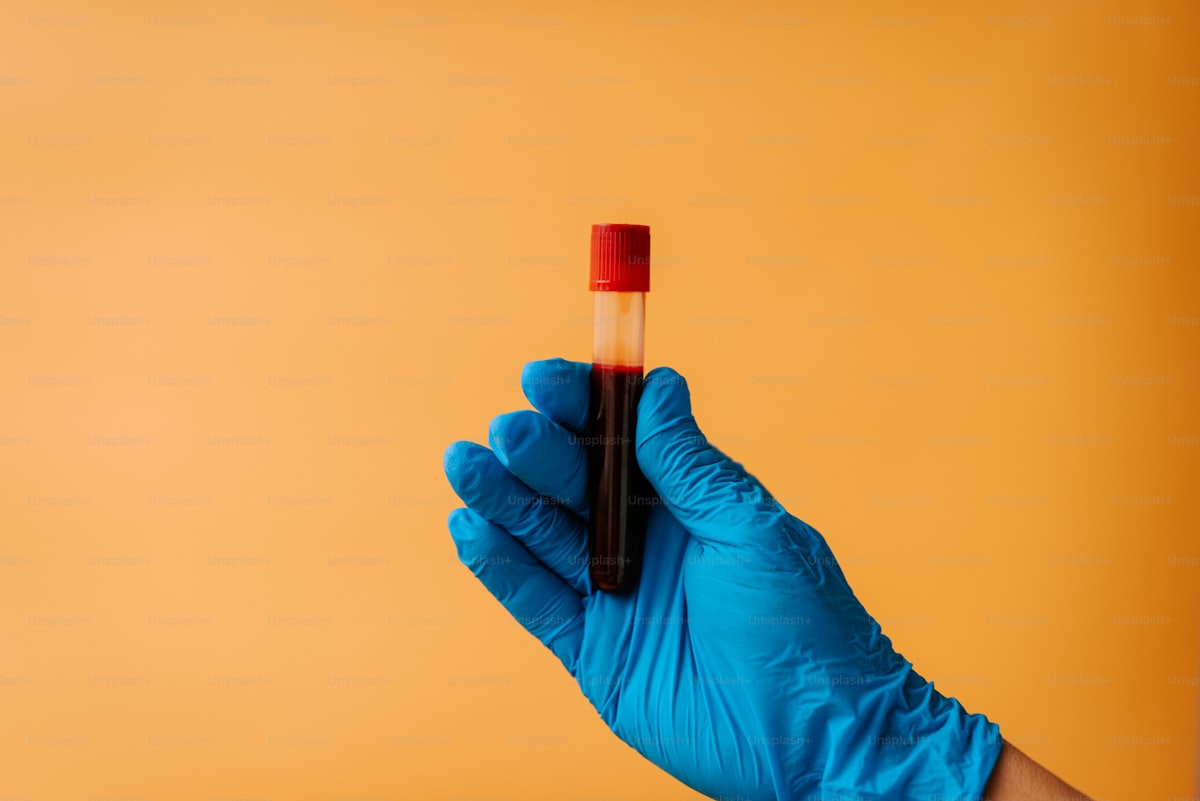

The only trustworthy CJC-1295 before-and-after is a pair of lab draws. Baseline IGF-1 before the first dose and a retest at 90 days tell you objectively whether the protocol moved the marker it is supposed to move. A photo at two weeks tells you nothing.
There is no honest before-and-after photo for CJC-1295 at two weeks. The molecule works on a biochemical clock first and a body-composition clock much later. What changes, and when, follows directly from IGF-1 kinetics.
- IGF-1 rises within days of the first dose and stays above baseline for up to 28 days with repeated dosing [1]
- The first weeks produce no reliable visible change. Early effects are biochemical and subjective, not photographic
- Measurable lean-mass change in the nearest GHRH-analog data took 16 weeks [3]
- Lean body mass can rise on a scale while measured strength does not, so read results carefully [4]
- A baseline IGF-1 and a 90-day retest are the only objective before-and-after that matters
Week 1 to 4: The Biochemical Phase
The first thing CJC-1295 changes is IGF-1, and it changes fast. A single dose raised IGF-1 1.5 to 3-fold for 9 to 11 days, and with repeated dosing mean IGF-1 stayed above baseline for up to 28 days [1]. One week after a dose, basal GH was 7.5-fold higher and IGF-1 was up 45%, while the pituitary kept its normal pulse pattern [2].
None of that is visible. There is no muscle to see and no fat loss to photograph in the first month. Anyone posting a dramatic 30-day transformation is showing you training and diet, not the peptide.
The most commonly reported early change is sleep quality, which tends to show up before any physical marker. Read it as a subjective signal that the axis is responding, not as evidence of body-composition change.
Response is not uniform. Some people show a brisk IGF-1 jump and others move slowly, which is exactly why a baseline draw matters. Without it, an unremarkable first month is impossible to interpret. You cannot tell a non-responder from someone who simply started at a higher baseline.
Month 2 to 3: Early Composition Shifts
By the second and third month, sustained IGF-1 elevation starts to register in tissue. In the closest long-term GHRH-analog study, nightly dosing increased skin thickness and, in men, lean body mass, with IGF-1 elevation appearing within 2 weeks and building over the 16-week course [3]. The composition change trailed the biochemical change by months.
This is where honest expectations matter. The lean-mass gain in that data was real but modest, and fat mass did not change significantly over the window [3]. Recovery between training sessions is often the first physical thing people notice, ahead of any measurable size change.
The 90-day mark is the first fair checkpoint. IGF-1 response is near its peak, so a retest here tells you whether the protocol moved the marker it is supposed to move.
Month 4 to 6: Where Real Change Is Judged
Body composition is a months-long readout, not a weeks-long one. The GHRH-analog lean-mass effect was measured at 16 weeks [3], and the GH-axis body-composition literature is measured in months. Six months is the standard minimum before deciding whether a protocol earned its place.
Set the bar correctly. GH-axis elevation increases lean body mass, but a systematic review of growth hormone in athletes found no measurable gain in strength or exercise capacity, and part of the lean-mass number reflected fluid retention [4]. A better scale reading is not automatically better performance.
How to Read the Scale Honestly
Early weight change on CJC-1295 is not all muscle, and treating it as muscle sets you up for a letdown at month four. GH-axis elevation drives fluid retention, so some of the first scale movement is water rather than tissue [4]. It is real, it is temporary, and it is not the lean mass you are training for.
Track more than one number. A tape measure at the waist, a strength log, and a 90-day IGF-1 draw together tell a truer story than the scale alone. If the scale climbs while the waist and the strength log stay flat, you are mostly reading water and normal week-to-week variation, not a body-composition win.
What a Real Before-and-After Looks Like
The only before-and-after worth trusting is a pair of lab draws. Baseline IGF-1 before the first dose, a retest at 90 days, and a comparison against the age-adjusted reference range. That tells you objectively whether therapy raised the marker and by how much.
- Weeks 1 to 4: IGF-1 rises, sleep may improve, nothing visible [1]
- Months 2 to 3: recovery improves, early and modest lean-mass shift in responders [3]
- Months 4 to 6: composition change becomes assessable; judge it against the 90-day IGF-1 retest [3]
- Throughout: strength and performance gains come from training, not the peptide [4]
No peptide produces a two-week transformation. CJC-1295 shifts a biochemical marker in days and body composition over months, and the size of that shift is modest. Photos that suggest otherwise are selling something.
How to Get an Honest Result
The people who get real results from CJC-1295 do three things. They train and eat for the goal, they measure IGF-1 at baseline and 90 days, and they give it 6 months before judging. The peptide supports that work. It does not substitute for it.
The biggest determinant of a clean before-and-after is not the molecule. It is whether a provider measured your starting point. A program that prescribes without a baseline IGF-1 cannot show you a real result, because it never established one.
A CJC-1295 result is only as honest as the labs behind it. SystemLabs includes clinician-guided IGF-1 monitoring and sources peptides from licensed U.S. pharmacies, so your before-and-after is a measured number rather than a photo.
Frequently Asked Questions
What results can I expect from CJC-1295 in 30 days?
Biochemically, IGF-1 rises within days and stays elevated for over a week per dose [1]. Physically, 30 days is too short for reliable visible change. The most commonly reported early effect is better sleep and recovery, not measurable muscle or fat loss. Any dramatic one-month transformation reflects training and diet, not the peptide.
How long before CJC-1295 shows physical results?
Plan on months. The nearest long-term GHRH-analog study measured lean-mass gain in men at 16 weeks, with IGF-1 rising within 2 weeks [3]. Recovery improves earlier. Visible composition change is a 3-to-6-month readout, and the 90-day IGF-1 retest is the first objective checkpoint.
Are CJC-1295 before-and-after photos real?
Some are, but the timeline is usually misrepresented. Real GH-axis body-composition change takes months and is modest in size [3][4]. A photo pair spanning a few weeks is showing training, lighting, and water balance, not a peptide effect. The trustworthy before-and-after is a baseline and 90-day IGF-1 comparison.
Will CJC-1295 make me stronger?
Not directly. GH-axis elevation raises lean body mass, but a systematic review of growth hormone in athletes found no measurable improvement in strength or exercise capacity [4]. Strength gains come from resistance training. CJC-1295 supports recovery and slow lean-mass change; it does not add force output on its own.
When should I retest IGF-1 on CJC-1295?
At 90 days. IGF-1 response is near its peak around that point, so a retest tells you whether the protocol raised the marker and where you sit in the age-adjusted range. Compare it to a baseline drawn before your first dose. Without both numbers, there is no objective before-and-after.
References
- Prolonged stimulation of growth hormone (GH) and insulin-like growth factor I secretion by CJC-1295, a long-acting analog of GH-releasing hormone, in healthy adults Journal of Clinical Endocrinology & Metabolism, 2006. PMID: 16352683. https://pubmed.ncbi.nlm.nih.gov/16352683/
- Pulsatile secretion of growth hormone (GH) persists during continuous stimulation by CJC-1295, a long-acting GH-releasing hormone analog Journal of Clinical Endocrinology & Metabolism, 2006. PMID: 17018654. https://pubmed.ncbi.nlm.nih.gov/17018654/
- Endocrine and metabolic effects of long-term administration of [Nle27]growth hormone-releasing hormone-(1-29)-NH2 in age-advanced men and women Journal of Clinical Endocrinology & Metabolism, 1997. PMID: 9141536. https://pubmed.ncbi.nlm.nih.gov/9141536/
- Systematic review: the effects of growth hormone on athletic performance Annals of Internal Medicine, 2008. PMID: 18347346. https://pubmed.ncbi.nlm.nih.gov/18347346/